
Compare at home, at your window.
Choose up to 12 free fabric samples and look at them in daylight and in the evening.
Choose your free fabric samples →Good to know
Here you will find answers to questions about wave curtains. Which fabric gives privacy? Will your track fit? And why is a width rounded up? Read the short answer or go on to the detailed explanation.
Search all questions and answers. You can also choose a topic below.
44 questions in six topics
01 / Your question
How are the waves formed, and what should you choose for your window?
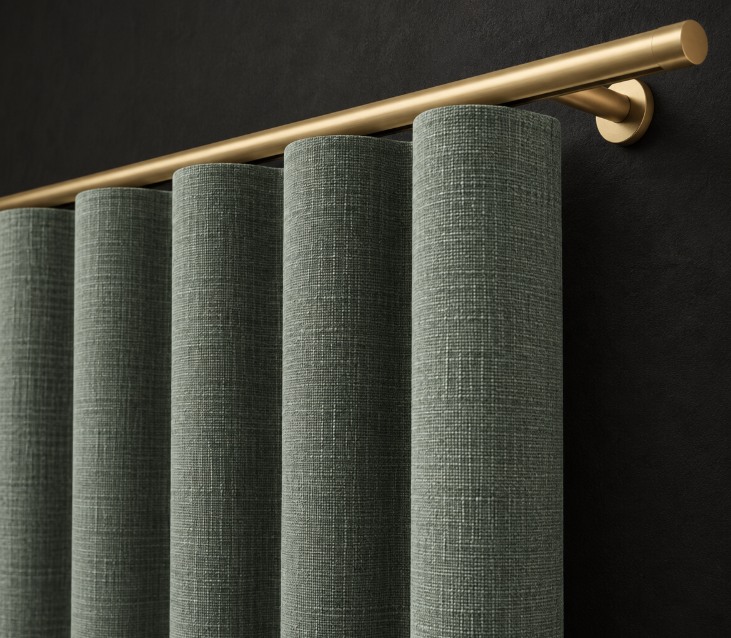
To all topics ↑With wave curtains, the fabric hangs in even S-shaped waves in front of and behind the track. Gliders on cord, wave tape and hooks keep that shape in place together. The folds are not stitched at the top as with a single or double pleat. See how wave works.
The 6 or 8 cm is the maximum distance between the gliders when the cord is taut. When the curtain opens, they slide closer together. With 6 cm you get more, smaller waves; with 8 cm the waves are fuller. 6 cm needs less depth, while the opened stack is narrower with 8 cm. Compare both options.
No. The glider spacing is not the same as the depth of the fabric. With our construction, for 8 cm wave we allow approximately 12 cm depth closed and 16 cm open. For 6 cm it is approximately 9 cm closed and 12 cm open. Also leave space to window handles and other obstacles. Check the clearance.
We make both with 200% fabric. With 6 cm glider spacing there is 12 cm of fabric between the hooks; with 8 cm it is 16 cm. Don’t double the width you enter yourself: we calculate the fabric needed. Read the explanation about tape and hooks.
The end spreader sits at the start and end of the curtain under the track. Two hooks hold the fabric in the right direction there, so the first and last waves sit neatly too. End spreaders come with our complete curtains. See the components.
Yes. Think beforehand about where the curtains should stack when open and whether the door can move freely. With little depth, 6 cm can be useful; if the space beside the window is limited, 8 cm has a narrower opened stack. Also measure the stack back space.
02 / Your question
Plenty of daylight, fewer views in or a dark bedroom: the fabric makes the difference.
To all topics ↑Voile is our most open fabric. Inbetween lets in plenty of daylight with less see-through. Our semi-sheer fabric is denser and screens the window more, but still lets light through. See the three fabrics side by side.
You can. When it is dark outside and the lights are on inside, shapes and silhouettes become more visible. Even inbetween and semi-sheer do not give complete privacy in every situation then. Combine them with an opaque curtain if you want more screening in the evening. See opaque curtains.
Not automatically. Our opaque curtain gives plenty of privacy, but can still let some light through. Dim out blocks much more light; blackout fabric lets no light through itself. Compare opaque curtain, dim out and blackout.
Our dim out blocks approx. 75–85% of the light, depending on the colour. Blackout lets no light through the fabric. If you want to sleep during the day or are sensitive to light, look mainly at blackout and at possible light gaps around your window. See the comparison.
The dark colours of our dim out fabric have more black thread woven in. As a result, they block more light than the light colours from the same collection. At home, compare a light and a dark sample at the same window. See dim out and the colours.
The fabric itself is lightproof, even in light colours. However, light can come in above, below, along the sides or between two curtain panels. The position of the track and how well it fits around the window therefore remain important. Read how to limit light gaps.
Yes, with a separate track for each layer and enough clearance. For example, you can combine inbetween with dim out. For two layers of 6 cm, our construction allows approx. 14 cm between the track centres and 28 cm total depth; for two layers of 8 cm approx. 18 cm and 36 cm. Obstacles may need extra space. Check the measurements for two layers.
No. Linen can be a colour name. The composition is listed separately for each fabric. Our inbetween, for example, contains 5% linen; semi-sheer is made of 100% recycled polyester. See all fabric specifications.
03 / Your question
Measure the track, choose the split and check the finished drop.
To all topics ↑Measure the total track width from end to end. On the product page, enter the total width, even if you choose two equal curtain panels. The calculator works out the matching order width. Follow the measuring instructions.
A wave curtain has to start and end with complete waves. That is why we work with fixed width steps. With one panel, we round the whole track width up; with two equal panels, we first divide the track width by two and round each panel up separately. Calculate the right width.
Measure from the underside of the track to the floor, in at least two and preferably three places. Normally take the shortest measurement and deduct 15 mm from it, following our measuring instructions. Enter that finished drop; the configurator does not deduct it again. See the measuring point and the explanation.
Measure in several places. With a height difference of approximately 2 cm or more, two separate curtains each with its own drop may fit better. Contact us before ordering and send your measurements and a photo. Let us take a look.
The maximum finished drop is 305 cm for voile, 285 cm for inbetween, 295 cm for semi-sheer and blackout, and 275 cm for textured weave, opaque curtain and dim out. The minimum drop is 40 cm. See the drops per collection.
With floor to ceiling making up, the wide measurement of the fabric becomes the curtain drop. The length of the roll runs across the curtain width. This lets us make each panel from one piece, within the maximum drop of that fabric. The top, sides and bottom are of course finished. Read more about floor to ceiling fabric.
The tables go up to approximately 8 metres total order width. The last matching size differs for 6 or 8 cm and one or two panels; the configurator shows the maximum for your choice. For larger sizes you can contact us. See how to design yours.
With our construction, you calculate the stack back as the number of gliders × 1.1 cm, plus 2 cm per panel for the end stop and end spreader. With two panels, calculate this for each panel separately. Check that space beside the window, especially with a sliding patio door. Use the calculator.
04 / Your question
A visible pole-style track or a track in a pelmet box: the system has to suit your curtain.
To all topics ↑Often you can, if suitable wave gliders on cord can run in it and the track can carry the curtain. The make, type and photos of the track and an existing glider help to check this. See what to look out for.
This is about the track profile and the type of glider that fits in it. It is separate from 6 or 8 cm wave: that measurement is the distance between the gliders on the cord. So choose both the right spacing and the right gauge. Read the explanation about gliders.
Yes, only together with your curtains; we don’t sell gliders separately. Choose white or black, for narrow gauge or wide gauge. The chosen 6 or 8 cm wave determines which four options you see. You also see the number of gliders, the cord length and the surcharge. We supply the right number, with white end spreaders for white gliders and black end spreaders for black gliders. If you already have enough suitable gliders, choose ‘Don’t include’. Choose your curtain.
From a pole-style track, yes, if suitable wave gliders can run in the channel. An ordinary round pole with loose rings does not give the same wave system. With a pole-style track, the round finish stays visible above the fabric. See pole-style tracks and finishes.
That depends on the clear internal dimensions. Measure the depth and check that both the closed curtain and the opened stack can move freely. 6 cm wave needs less depth than 8 cm. Also make sure you can still reach the track later. See the explanation about a pelmet box.
Yes, with a suitable track system and matching wave gliders. With a motorised track, factors such as length, weight, opening and power supply all count. With a bend, the gliders must be able to run through smoothly. Send us your situation before you order. See the track options.
No. Your curtain is made up complete with wave tape, inserted hooks and end spreaders. The fixed bottom finish is included too. The track gliders are a separate option, because your track may already have them. See what is included.
Voile, inbetween and semi-sheer get weighted hem tape for extra weight at the bottom. Textured weave, opaque curtain, dim out and blackout get a 10 cm bottom hem. This finish belongs to the chosen fabric. See the finish per fabric.
05 / Your question
See the real fabric at your window before you choose a colour.
To all topics ↑Yes. You can request up to 12 free fabric samples, including from different available collections. Delivery is free and you don’t need to enter any payment details. Choose your free samples.
Normally the same day or within 24 hours. They are sent by post in a letterbox box. That is the dispatch time; the actual delivery day depends on the postal service. Read more about the sample request.
No. You can keep the samples and you don’t need an account. To send them, we ask for your name, address and email address; your phone number is optional. See the available samples.
On the product page, choose the same fabric type and the same colour number, for example Inbetween 01 white. The number and name are shown below each small colour image. Click the colour and check the chosen fabric before you continue. Go to the fabrics to order.
Not necessarily. The weave, yarns and fabric type affect how the colour looks. Two colours with the same name or number can therefore differ. Look at the real samples side by side in daylight and in your evening lighting. See colour choices and examples.
Yes. The thin textured weave is available in 100 cream white, 051 ivory, 05 ecru, 07 beige, 021 light grey and 02 grey. You can combine these samples with the other fabrics, up to a maximum of 12 free samples. See the available fabrics.
06 / Your question
From your colour choice to the curtain on your track.
To all topics ↑First choose the fabric and colour. Then choose 8 or 6 cm wave and the split: two equal panels, one panel left or one panel right. Enter the total width and finished drop and choose gliders if needed. Check the summary before you put the curtain in the basket. Start with your fabric choice.
On the product page, the curtain price appears as soon as the width, wave and split have been chosen. Any gliders appear as a separate surcharge in the summary. A valid drop must also be entered before you can add the curtain to the basket. Design your curtain.
Contact us with your track width, the drop you want, the fabric and your wave choice. With a very wide track, two separate orders, one panel left and one panel right, can be a solution. The width table then applies to each panel separately. If in doubt, have the option checked beforehand. Ask about the options.
We make your curtains to measure in the Netherlands and aim for a production time of no more than 8 working days for normal online made to measure orders. Delivery follows after that. If you have a fixed date in mind, contact us before ordering to discuss it. See production and delivery.
The finished curtains are transported hanging and free of charge by a specialist carrier. This means they don’t have to be folded up small in a parcel box. Delivery days vary by postcode area. Read how delivery works.
Yes, all curtain fabrics in our collection can be washed at 30 °C. Remove the hooks from the curtain tape or put the curtain with the hooks in a laundry bag. Take a photo of the hook positions beforehand, so you can put them back in the same place afterwards. Wash the curtains without other clothes and choose a low spin speed. After washing, hang them back on the track and close the curtains, so the fabric hangs spread out and can dry properly. Leave them to dry there for 24 hours, and longer if the fabric is still damp. Bear in mind that drips may fall on the floor and protect it if necessary. See the explanation about rehanging.
Contact us as soon as possible. Mention your order number and send an overview photo and a clear detail photo; for transport damage, a photo of the packaging also helps. Then we can look into it specifically. See service and complaints.
Yes. Send a photo of the whole window, a detail of the track or pelmet box and your rough measurements. You can attach photos and PDF files in the contact form. For final measurements, always use the measuring instructions. Send your question with photos.
Try a shorter word, such as ‘track’ or ‘fabric’. You can also send us your question, with a photo if that helps.
Ask your question →We are happy to take a look
Send an overview photo, a detail of the track or pelmet box and your rough measurements. Then we can give a more specific answer.
Ask your question with photosOr call +31 85 273 63 78Choose up to 12 free fabric samples and look at them in daylight and in the evening.
Choose your free fabric samples →Choose colour, wave, split and sizes. Tape, hooks and end spreaders are included.
Design your wave curtain →From fabric sample to made to measure